Usage
## S3 method for class 'nbreg'
predict(object, newdata,
  type = c("response", "prob", "theta", "parameters"), na.action = na.pass, ...)
## S3 method for class 'nbreg'
residuals(object, type = c("pearson", "deviance", "response"), ...)

## S3 method for class 'nbreg'
coef(object, model = c("full", "mu", "theta"), ...)
## S3 method for class 'nbreg'
vcov(object, model = c("full", "mu", "theta"), ...)

## S3 method for class 'nbreg'
terms(x, model = c("full", "mu", "theta"), ...)
## S3 method for class 'nbreg'
model.matrix(object, model = c("mu", "theta"), ...)
Details
A set of standard extractor functions for fitted model objects is available for objects of class “nbreg”, including methods to the generic functions print and summary which print the estimated coefficients along with some further information. The summary in particular supplies partial Wald tests based on the coefficients and the covariance matrix. As usual, the summary method returns an object of class “summary.nbreg” containing the relevant summary statistics which can subsequently be printed using the associated print method.
The methods for coef and vcov by default return a single vector of coefficients and their associated covariance matrix, respectively, i.e., all coefficients are concatenated. By setting the model argument, the estimates for the corresponding model component can be extracted.
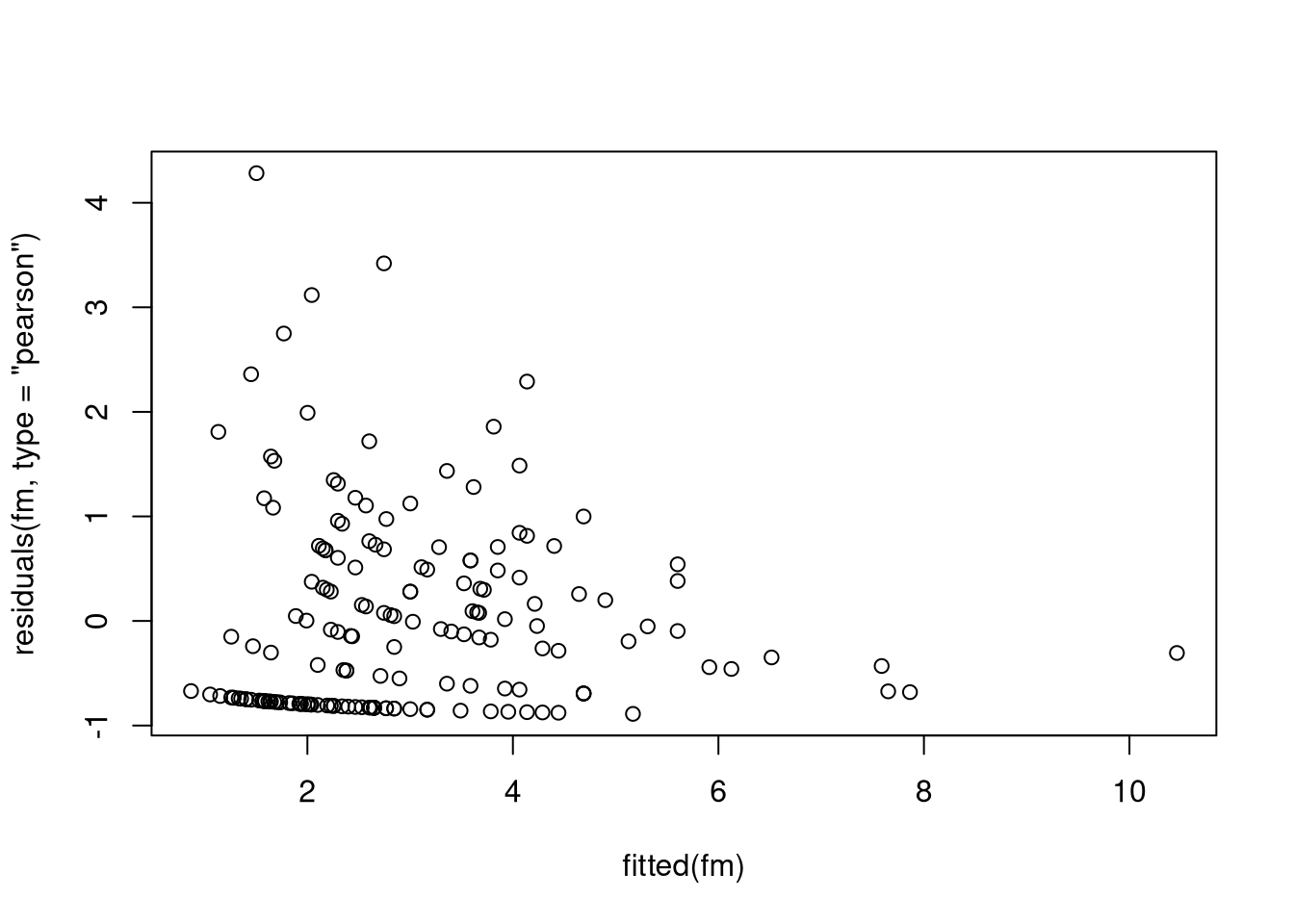
Both the fitted and predict methods can compute fitted responses. The latter additionally provides the predicted density (i.e., probabilities for the observed counts) and the predicted dispersion parameter theta. The residuals method can compute raw residuals
(observed - fitted), Pearson residuals (raw residuals scaled by square root of variance function), and deviance residuals. The latter are only supported for negative binomial type 2 models (dist = NB2) (includes NBH).
A logLik method is provided, hence AIC can be called to compute information criteria.